Showing posts with label Super Mario Bros. Show all posts

Wednesday, June 9, 2010

Thoughts on Video Game Movies

A movie based on a video game should only be made if the game has a good story that stands on its own.  To think that a movie should be made out of a game because the game is fun and popular is so absurd it’s hard to understand how anyone could believe it.  Cashing in on name recognition is the motivation of Hollywood, but there’s no reason to think a good movie will result.

Of course, when the movie fails commercially and critically, fans of the game blame that failure on the movie’s lack of fidelity to the game.  That is about the most idiotic thing imaginable.  Super Mario Bros was a great game.  To be faithful to the game, the movie could have been a 90 minute sequence of Mario and Luigi stomping on mushrooms and turtles, jumping on bricks and clouds, sliding down flagpoles, and shooting fireballs.  There would be very little dialog.  That would be a great movie – right, video game fans?  (I ask that rhetorically, but the scary thing is that there are probably people who would think that would be great as long as the movie had great special effects and Megan Fox playing the princess.)

3295839344_43dce716fcSomeone could say, “okay, Super Mario Bros wouldn’t work, but something like Street Fighter would.  That game had a great premise and would have made an awesome movie if they would have stuck to it.”  Of course, even fans of SF2 games admit the game’s story is nonexistent and the endings for each of the characters are pointless wastes of time – even the endings of the latest game, Super Street Fighter 3.

Here’s what I think goes through the mind of some video game fans. “Video game have great stories, but non-gamers don’t appreciate them because they think video games are childish or something.  If a movie was made of out game x, people would see how profound its story is and maybe even change their attitudes about video games.”  It’s hard to articulate just how wrong that kind of thinking is.  Every video game movie so far has had the opposite effect – instead of changing anyone’s mind about video games, they’ve cemented people’s beliefs that games have juvenile, hackneyed stories.

The answer to why video game movies are bad is obvious – games are good for reasons other than their stories.  Games don’t necessarily have bad stories, but the bar is so low that a mediocre story in a video game can seem a lot better to the gamer than it actually is.  A good game can make a bad story tolerable.  But if a game is bad, even a great story won’t save it from being bad.

Ironically, for all the complaining about video game-based movies not being faithful to their source material, people are praising the recently-released Mortal Kombat short (“Mortal Kombat: Rebirth”), which is completely unfaithful to any Mortal Kombat game I’ve ever played.  I don’t recommend watching the video since it’s a tasteless, pretentious piece of drivel, but if you must watch if you can find it here.  Why are they praising it?  Because it’s full of the pseudo-dark elements that the juvenile-minded think make a movie serious and profound.  But as I’ve mentioned before, fans of this type of stuff aren’t interested in exploring real evil, only a fantasy world where serial killers are interested in competing in martial arts tournaments.

In any case, if a game has a great story (i.e. a story that would be great in another context), I’m open to the possibility of a good movie being made based on it.  But people need to discard the idea that a movie can be good if it’s just faithful to the game.

Thursday, May 20, 2010

Sick of Playing Level 1

Smb3 I’m too lazy and unqualified to critique the video game canon list created by video game scholars.  Everyone’s going to have their own ideas about what should and shouldn’t be on a list like that, but few people were continuously up-to-speed on developments in both the PC and console gaming worlds throughout the 70’s, 80’s, 90’s, and 00’s.   I have more gaming experience than most people, but I wouldn’t pretend to have enough perspective to be able to assess how important any particular game is.  It sure seems like a game like Doom is important, but didn’t Wolfenstein 3D pave the way for Doom?  How do you include Doom on the list but not Wolfenstein?  The list doesn’t seem important enough to put time or effort into researching and arguing for or against a game’s inclusion.  It would be a different story if I was getting paid to do that.

I’m mainly interested in the scholars’ defense of Super Mario Bros 3’s inclusion.  The article says it was included because, “its nonlinear play, a mainstay of contemporary games, and new features like the ability to move both backward and forward.”  I’ve got to agree with that reasoning and emphasize how cool a feature like that was and is.

http://www.blogcdn.com/nintendo.joystiq.com/media/2007/11/mario_3_vcmm.jpg

In case anyone isn’t clear on what nonlinearity means, think of the first Super Mario Bros game.  The game always starts on level 1-1.  You beat the level and go to level 1-2.  At certain points you can warp ahead, skipping some levels.  But you can never go back, and never avoid starting the game on level 1-1.

Most of the games of the 8-bit and 16-bit eras are like that – certainly the majority of side-scrolling action/platform games.  Players just accepted that, but we were all secretly and not-so-secretly sick of playing level 1 every time we to played the game.

Super Mario 3 featured an overworld that meant the gamer didn’t have to always start the game at the first level.  He could play any level he previously passed.  This was unheard of at the time.

Super Mario 3 was not the first game to implement this.  Bionic Commando did have an overworld, but it’s wasn’t as nice.  In addition to the interface being clunky and unattractive, the lack of progress saving limited its usefulness.

http://www.elitecoder.com/bionic/walk/index_files/imgmap.gif

Progress-saving combined with the overworld really put SMB3 ahead of its time.

I was an early adopter of the Genesis, and although I owned an NES, I was contemptuous of the NES, Nintendo, and gamers who only owned an NES (yes, I was a gaming elitist).  The 16-bit era had arrived, but Nintendo continued to milk the NES.  I realized that it made good business sense for Nintendo to do that, but I wished consumers would forsake their 8-bit consoles for the superior graphics and sound of the Genesis (or the TurboGrafx-16 – yeah right).  In any case, SMB3 is the one NES game that I was envious of.  I wished that game developers for the Genesis would have put some of those features in the 16-bit games.  But they didn’t get it, and some of them still haven’t gotten it.

The funny thing is, making a game non-linear would have been easy to do.  The overworlds themselves don’t have to be graphically impressive.  SMB3’s definitely was not beautiful.  They just have to work.  They’re basically graphical level selection screens.  That’s all they have to be.

MD_Sonic_the_Hedgehog-738766 Sonic the Hedgehog was released in 1991 – three years after the Japanese release of SMB3.  The developers would have know about the innovations of SMB3.  And while Sonic blew the Super Mario games out of the water in terms of graphics and sound (including Super Mario World for the SNES), its lack of an overworld and progress saving hurt its overall quality and in particular its replayablity.

Sega didn’t learn this until Sonic Adventure for the Dreamcast.  As far as I know, that was the first Sonic game to have an overworld (which, at that point in gaming, had evolved into an immersive 3D environment with the same controls and graphical quality as the particular levels).  The Genesis Sonic games – Sonic 2, Sonic & Knuckles, Sonic 3 – all lacked an overworld and progress saving.  I’m not even convinced that the upcoming Sonic 4 will have a an overworld or more importantly, level selection.

Why didn’t more developers in the 80’s and 90’s see that as an important feature?  I’m guessing that it’s because nonlinearity does not sell games – at least not back then.  Gamers mainly wanted better graphics and sound.  We wanted screen shots of games showing the best the games had to offer graphically.  If a game had nice graphics, that was 75% of the sale.

Take a look at these screens:

http://media.giantbomb.com/uploads/0/4527/1089945-buster_super.gif

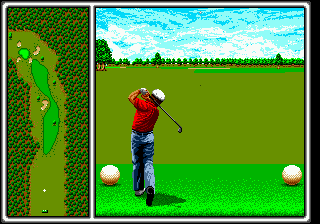
http://www.vizzed.com/vizzedboard/gen/screenshot/Arnold%20Palmer%20Tournament%20Golf-2.png

These are from James 'Buster' Douglas Knockout Boxing and Arnold Palmer Tournament Golf, respectively.  At the time, those graphics were unbelievable.  When a person would come across an ad featuring those screens in a magazine, the only reaction was “wow!”  The games themselves were bad, but they were effective marketing for the Genesis.  They’re colorful, exciting, detailed, and beyond what was possible on the NES.

So the motivation for developers to put “deep” features like nonlinearity and progress saving in games was not as high as it was for them to load up games with cutting-edge graphics and sound.  That’s still the case.  Overworlds are not particularly exciting.  But as I said, they add to replayability, they make games less linear, and they make games feel more substantial.

The main lesson here is that the best features of games – the features that become standard in later generations of games – are often the small things that seem inconsequential.  Whereas the graphics will look less impressive over time, innovative and substantive features tend to stand out even when looking back at a game 20 years later.