IGN's video review of the game, Shovel Knight calls it [the reviewer's] favorite game of 2014 so far. How can that be, with games like Titanfall and Watch Dogs coming out this year? And if someone really likes retro games, what about Strider HD or Trials Fusion?
Now, I haven't played Shovel Knight and don't want to. It looks fun enough, but I played so many games like that in the 8-bit and 16-bit era, and I've moved on. If I'm going to play a game with old school controls, it's going to be a game that at least attempts to meet modern presentation standards.
Shovel Knight does not look good to me. It wouldn't have looked to me in the 16-bit era. Okay, fine, it's supposed to represent an 8-bit game and not a 16-bit game. But back then I always wanted games to look better than they did. The developers were always trying to make their games look better. That's what I don't understand about the more recent Megaman games. They released better-looking Megaman games on the SNES than Megaman 10 looks on PS3 and Xbox. Why go backwards?
Is Shovel Knight really better than Strider HD? I wonder how many people who are exited about Shovel Knight gave Strider HD a chance. Strider HD (like the amazing Bionic Commando: Rearmed), shows that you can take an old game, preserve everything that was good about it, improve on its weaknesses, and make it look great by today's standards.
Shovel Knight doesn't try to meet today's standards, of course. I'm guessing that retro-looking games sell better than retro-style games that don't look retro. So I can excuse the developers. But gamers should demand better. I understand wanting the retro experience. I understand wanted a change of pace with simpler controls. But you can get those things without dated graphics and sound.
I'm open to the arguments of retro gamers who prefer games that look and sound old. Why do you prefer that? Have you played Bionic Command: Rearmed, Strider HD, Contra Hard Corps, the remake of Castle of Illusion, etc.? If you have, and you still prefer Shovel Knight, tell me why.
Showing posts with label Bionic Commando. Show all posts
Showing posts with label Bionic Commando. Show all posts
Friday, June 27, 2014

Saturday, February 19, 2011
Converted To Modern Games

Modern games are better and more fun to play than retro games. That may not sound like a bold proclamation, but for me it represents a complete attitude change.
It’s been about a year since I bought an Xbox 360 and started this blog. If you remember, I mainly got the Xbox is order to play old school style games. A good example is Bionic Commando:Rearmed. At the time, that was exactly the type of game I was looking for (and still the best remake of an 8-bit game ever, in my opinion).
But, if you look over my blog posts over time, I started to be more enthusiastic about modern games. It started with Batman:Arkham Asylum. Then it was Transformers: War For Cybertron. But the final step of my conversion has been Red Dead Redemption.
Early on, I thought that playing the modern games was just a diversion, and that my main interest would still be old school games. The games I was looking forward to most were Castlevania: Harmony of Despair, Bionic Commando: Rearmed 2, and Hard Corp: Uprising. Those games are all out now. They are good games (well, I have problems with Castlevania:HD). But, I have no plans to buy the full versions.
The reason is, I just find them boring. The control is too basic. When I’m used to 3D games with deep, complex controls, I just can’t “switch gears” to enjoy the old school gameplay. I mentioned this in my assessment of the Limbo demo last year. At the time I didn’t realize that was I was feeling was not temporary, but a permanent change in my attitude.
Simple mechanics are one of the reasons that many people prefer retro games. You can pick up and play them without having to learn much or train your hands. Games with deep controls can have a steep learning curve that can be intimidating. I can speak to that because that I how I felt a year ago. But I can now say, the learning curve is worth it. It seems daunting at first, but you will adapt in time. And it doesn’t even take that much time. At a certain point, the controls become second nature and don’t even seem complex. And when you reach that point, playing the game becomes entertaining and rewarding beyond what’s possible in an old school game. Here are a couple of examples.

In Batman:Arkham Asylum, you can use Batman’s line launcher to zip-line across a room and knock down a group of henchmen. Before they get up, you can use a ground takedown move to knock one of them out. By that time the others will have gotten up and and will most likely be ready to open fire on Batman with machine guns. At that point you can either retreat by grappling up to gargoyle, stun them using Batman’s cape, use batarangs to knock them down again, or just run at them kicking and punching, hoping to take them out before Batman is critically wounded. There are so many options – you can let your creativity run wild. It takes a high level of comfort with the game’s controls to be able to do all that, but the gamer does get to that level, and it happens naturally (in this game, at least).

Another example is from Read Dead Redemption. You can take something that happens in the game fairly often – a thief steals a horse and a townsperson asks you to get the horse back. You have a lot of options in RDR, but I like to return the horse and the thief alive. Here are the steps required for that:
- Whistle for horse
- Mount horse
- Equip lasso
- Look where thief is on mini-map and chase after him
- Once caught up to thief, ready lasso
- Enter dead-eye mode
- “Paint” thief in dead-eye mode
- Throw lasso
- Dismount house
- Run to to thief and hogtie him
- Pick up thief
- Put thief on horse
- Mount house
- Chase down stolen horse and lasso it
- Lead horse back to robbery victim
- Dismount horse
- Remove thief from horse
- Drop thief off ground
So why is that more satisfying than say, defeating a monster in The Legend of Zelda. I don’t know. It’s something that I know experientially. Maybe I’ll try to think of the specific reasons in a future post. For now I can only say that I am a convert.
Thursday, May 20, 2010
Sick of Playing Level 1

I’m mainly interested in the scholars’ defense of Super Mario Bros 3’s inclusion. The article says it was included because, “its nonlinear play, a mainstay of contemporary games, and new features like the ability to move both backward and forward.” I’ve got to agree with that reasoning and emphasize how cool a feature like that was and is.

In case anyone isn’t clear on what nonlinearity means, think of the first Super Mario Bros game. The game always starts on level 1-1. You beat the level and go to level 1-2. At certain points you can warp ahead, skipping some levels. But you can never go back, and never avoid starting the game on level 1-1.
Most of the games of the 8-bit and 16-bit eras are like that – certainly the majority of side-scrolling action/platform games. Players just accepted that, but we were all secretly and not-so-secretly sick of playing level 1 every time we to played the game.
Super Mario 3 featured an overworld that meant the gamer didn’t have to always start the game at the first level. He could play any level he previously passed. This was unheard of at the time.
Super Mario 3 was not the first game to implement this. Bionic Commando did have an overworld, but it’s wasn’t as nice. In addition to the interface being clunky and unattractive, the lack of progress saving limited its usefulness.

Progress-saving combined with the overworld really put SMB3 ahead of its time.
I was an early adopter of the Genesis, and although I owned an NES, I was contemptuous of the NES, Nintendo, and gamers who only owned an NES (yes, I was a gaming elitist). The 16-bit era had arrived, but Nintendo continued to milk the NES. I realized that it made good business sense for Nintendo to do that, but I wished consumers would forsake their 8-bit consoles for the superior graphics and sound of the Genesis (or the TurboGrafx-16 – yeah right). In any case, SMB3 is the one NES game that I was envious of. I wished that game developers for the Genesis would have put some of those features in the 16-bit games. But they didn’t get it, and some of them still haven’t gotten it.
The funny thing is, making a game non-linear would have been easy to do. The overworlds themselves don’t have to be graphically impressive. SMB3’s definitely was not beautiful. They just have to work. They’re basically graphical level selection screens. That’s all they have to be.

Sega didn’t learn this until Sonic Adventure for the Dreamcast. As far as I know, that was the first Sonic game to have an overworld (which, at that point in gaming, had evolved into an immersive 3D environment with the same controls and graphical quality as the particular levels). The Genesis Sonic games – Sonic 2, Sonic & Knuckles, Sonic 3 – all lacked an overworld and progress saving. I’m not even convinced that the upcoming Sonic 4 will have a an overworld or more importantly, level selection.
Why didn’t more developers in the 80’s and 90’s see that as an important feature? I’m guessing that it’s because nonlinearity does not sell games – at least not back then. Gamers mainly wanted better graphics and sound. We wanted screen shots of games showing the best the games had to offer graphically. If a game had nice graphics, that was 75% of the sale.
Take a look at these screens:

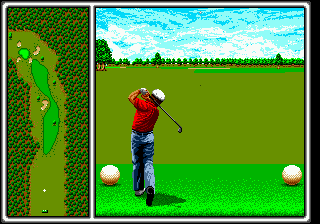
These are from James 'Buster' Douglas Knockout Boxing and Arnold Palmer Tournament Golf, respectively. At the time, those graphics were unbelievable. When a person would come across an ad featuring those screens in a magazine, the only reaction was “wow!” The games themselves were bad, but they were effective marketing for the Genesis. They’re colorful, exciting, detailed, and beyond what was possible on the NES.
So the motivation for developers to put “deep” features like nonlinearity and progress saving in games was not as high as it was for them to load up games with cutting-edge graphics and sound. That’s still the case. Overworlds are not particularly exciting. But as I said, they add to replayability, they make games less linear, and they make games feel more substantial.
The main lesson here is that the best features of games – the features that become standard in later generations of games – are often the small things that seem inconsequential. Whereas the graphics will look less impressive over time, innovative and substantive features tend to stand out even when looking back at a game 20 years later.
Wednesday, March 31, 2010
Sonic the Hedgehog 4 - One Piece of Advice for Sega

If these Sonic the Hedgehog 4 videos are legitimate, the game looks good and about what I'd expect from a 2D Sonic on a current generation console. Since it will be an XBox Live Arcade game, I'm sure I'll be willing to shell out $10-$15 for it.
But I would suggest this to Sega -- zoom the camera out at times. Perhaps you could have it zoom out in proportion to how fast Sonic is moving. Capcom used a variable zoom level in Bionic Commando:Rearmed to great affect. I actually think anyone releasing an updated version of an old school game should look closely at all the things done right in Bionic Commando:Rearmed. The way it handles 2 players would also be a good model for Sonic. The camera zooms out as the players get further away from each other. When they get too far about, the screen splits. I don't know if Sega plans to make Sonic 4 two players, but if they do they should use the Bionic Commando system or one like it.
Subscribe to:
Posts (Atom)